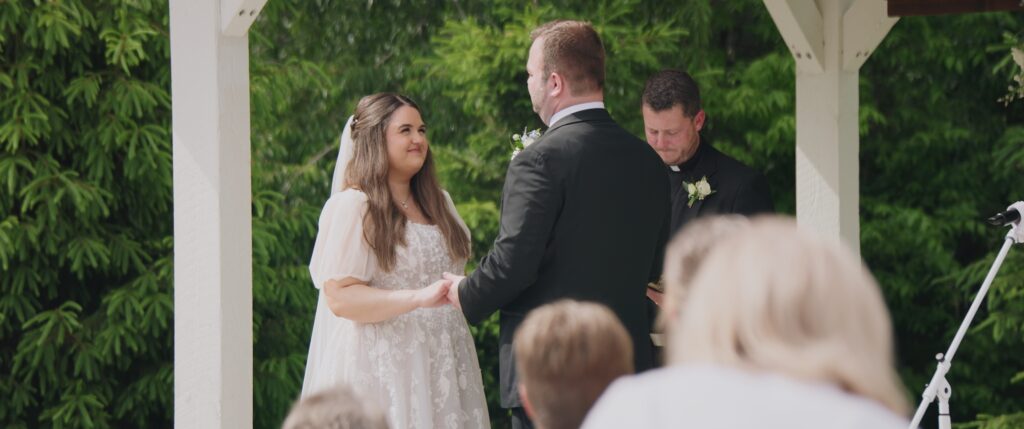
The ceremony is the reason the wedding day exists.
It’s where promises are made, families become one, and two people begin a new chapter together. Yet when couples think about wedding films, they often picture a short cinematic highlight rather than the ceremony itself.
The truth is, the two serve very different purposes.
That’s why every wedding I film includes two films from one wedding day: a cinematic film that tells the story of your wedding, and a documentary film that preserves it. The cinematic film captures the emotion and atmosphere of the day. The documentary film lets you experience it again, exactly as it happened.
Years from now, you may discover that the ceremony is the part you return to most.
The ceremony is more than the vows
When people think about a wedding ceremony, they usually remember the obvious moments: the walk down the aisle, exchanging vows, the first kiss.
Those moments deserve to be remembered.
But with time, it’s often the quieter moments that become the most meaningful.
The nervous laugh before you begin your vows.
The way your partner reaches for your hand.
Your parents’ expressions from the front row.
A reading from someone who is no longer with you.
The pause before the officiant pronounces you married.
These moments are rarely dramatic. They’re simply real. And because they’re real, they become more valuable as the years pass.
A cinematic wedding film may include pieces of them, but a full ceremony allows those moments to unfold naturally, without being condensed into a few seconds.
Two films. Two different purposes.
A cinematic wedding film and a full ceremony film aren’t alternatives. They complement each other.
A cinematic film is carefully crafted to tell the emotional story of your wedding day. Through music, pacing, natural audio, and thoughtful editing, it captures what the day felt like. It’s often the film couples share with family and friends.
A documentary film serves a different purpose.
Instead of condensing the day, it preserves it.
The ceremony happens from beginning to end. The readings remain intact. The vows aren’t shortened. The pauses, laughter, and quiet moments all stay exactly where they belong.
Neither approach is better than the other.
One tells the story.
The other preserves the memory.
The value changes over time
One thing I’ve noticed over the years is that couples are usually most excited to watch their cinematic film right after the wedding.
It’s emotional. It’s beautifully edited. It’s easy to share with friends and family.
But as the years pass, many couples find themselves returning to the documentary film more often.
Life changes.
Parents grow older.
Children arrive.
Friends move away.
Voices become more precious.
The ceremony slowly transforms from a record of your wedding into a record of the people who shared that moment with you.
That’s something a short highlight film simply can’t replace.
Every ceremony deserves to be preserved
Some ceremonies last twenty minutes.
Others last more than an hour.
Some take place in historic churches. Others happen outdoors beneath the trees or inside a quiet courthouse.
None of that determines their importance.
A traditional religious ceremony may include readings and traditions that deserve to be experienced in full. A ceremony filled with handwritten vows may tell your story in a way no edited montage ever could. Even the simplest ceremony becomes irreplaceable because of the people gathered to witness it.
Every ceremony is unique because every relationship is unique.
Seeing the moments you missed
On your wedding day, you’re living the experience—not watching it.
You won’t see your parents’ reactions while you’re reading your vows.
You won’t notice your grandparents smiling from across the aisle.
You may never realize the way your wedding party looked at each other during the ceremony.
A thoughtfully filmed ceremony lets you experience those perspectives for the first time while still keeping the focus exactly where it belongs: on the two of you.
Great ceremony films begin with great audio
Beautiful images matter.
But when couples revisit their ceremony years later, it’s usually the voices they treasure most.
Your vows.
Your officiant’s message.
A sibling reading Scripture.
A grandparent laughing quietly in the front row.
These are the sounds that bring people back to the day.
That’s why recording clean, reliable audio matters just as much as beautiful camera work. Every ceremony presents different challenges, whether it’s a windy outdoor venue, a large church, or a busy event space. Careful preparation makes it possible to preserve the words that matter most.
An unobtrusive approach
The best ceremony films don’t require the ceremony to become a production.
You shouldn’t be thinking about cameras while you’re exchanging vows.
With thoughtful preparation, respectful camera placement, and careful audio recording, your filmmaker can document the ceremony without distracting from it.
The goal isn’t to create a performance.
The goal is to preserve a real one.
A film you’ll appreciate for decades
Wedding days move quickly.
The flowers are packed away.
The decorations come down.
The music ends.
What remains are the promises you made and the people who stood beside you while you made them.
That’s why I believe every couple deserves more than a highlight film.
A cinematic film tells the story of your wedding day.
A documentary film preserves the day itself.
Together, they become something you’ll return to throughout your marriage—not just because they’re beautiful, but because they’re true.